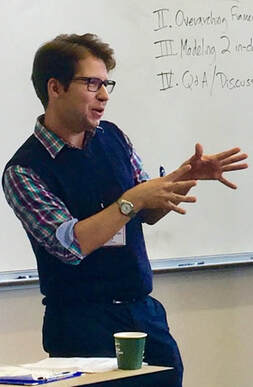
Stephen M. DiDomenico - Doctoral Student
  • Home
  • CV
  • Research
  • Teaching
  • About Me


Teaching


I enjoy teaching courses aimed at analyzing and reflecting upon our "everyday" communicative practices (such as public speaking, interpersonal interaction, interviewing, etc.) as well as broader surveys of the field or traditions of communication theory. In addition to teaching as a Graduate Student Instructor, I have taught students at the middle school level (in ESL - English as a Second Language), high school level (Interpersonal Communication & Introductory Philosophy), and the community college level (Introductory Public Speaking).

COURSES I HAVE TAUGHT:


"Interpersonal Communication Theory"
(COM 355, Rutgers)

Picture
This is an advanced theory course that addresses a most important and pervasive aspect of human experience: interpersonal communication, including both verbal and nonverbal aspects of social interaction. In fact, some scholars have argued that our unique brand of interaction is at the root of what makes us human. This course provides an opportunity to learn about how a set of core theoretical and methodological tools – primarily those drawn from three foundational thinkers: Goffman, Bateson, and Bahktin - can be productively applied to communication in real-world contexts. We will explore how social interactions link speakers to a range of social and cultural realities. From this, we will see how talk not only reflects such realities, but also constitutes them. Embracing the interdisciplinary nature of communication inquiry, our explorations of these issues will draw on research from the disciplines of sociology, pragmatics, sociolinguistics, communication, social psychology, and anthropology. Please note that although the world of everyday experience is our starting point, this is not a class about "how to communicate." Rather, by placing communication processes at the center of social life, we put ourselves in the position to see how core aspects of our everyday encounters are recurrently being (re)constructed and (re)negotiated.


  1. "Introduction to Communication"
    (COM 101, Rutgers)

Picture
This course will introduce you to the scholarly field of Communication Studies. We are all "lay" experts in communication; however, throughout this course we will work to recognize differences between vernacular and scholarly approaches to communication. Topics will be drawn from major areas of communication theory and research  (e.g., verbal & nonverbal communication, linguistic issues, intercultural communication, the self, politeness, relationships, mediated and organizational communication, models of communication and more). We will actively engage a number of ideas central to communication through in-class discussions of the literature and in-class collaboration exercises. The goal is to open your mind to scholarly ways of thinking about the phenomena of communication and information in our everyday lives, thus transforming your “lay” expertise to an academic, critical-thinking approach to examining questions about communication phenomena. 


"Communication Theory"

(Marymount Manhattan College)

Picture
This course surveys the questions and theoretical issues that interest the people who inhabit the academic discipline of Communication Studies.  As an introductory course in communication theory, it will examine the development and content of the major perspectives that have been used in the study of human communication.This course is intended to acquaint you with the major philosophical conceptions and social scientific theories that have generated discussion and research in the study of human communication. Another basic goal is your development of a critical attitude toward theory (and theorizing). In short, the purpose of this course is to enable you to gain an understanding of "communication" as a multitheoretical, multidimensional, and interdisciplinary social process. 


"Interpersonal 
Communication Processes"
(Rutgers: COM 201)

Picture
How does everyday communication between two people work? What does it take to maintain a friendship these days? Why is it that communication skills are the number one thing that employers look for in the ideal job applicant? The purpose of this course is to introduce theory, concepts, and research in the study of interpersonal communication.  It is designed to create awareness of communication issues that we often take for granted—and that may cause misunderstanding in everyday social interaction. In particular, we will focus on the process of communication, the production of meaning in interpersonal contexts, analyzing aspects of theory underlying competence in verbal and nonverbal communication, perception and interpretation, language, identity, and relationship building. Although this is not a course in “how to best communicate” per say, the application of concepts and theories to one’s own life is strongly encouraged so that we may become more successful communicators in society. 

"Interviewing: Theory & Practice"
(Rutgers: COM 360; Illinois: CMN 115)

Picture
In the broadest sense, whether it be asking your classmates about a class session you missed or exchanging  personal beliefs with a potential romantic partner, interviewing is an important part of our everyday communicative practices. According to communication scholar John Daly, interviewing is a concentrated attempt to understand another person through direct and immediate  communication.  In this course, we will examine interviewing as a genre of social interaction, that is used to collect and disseminate spoken information under a variety of conditions. Put another way, this semester we will explore a range of different types of goal-focused conversation. 

"Fundamentals of Public Speaking" 
(Rutgers: COM 220; Illinois: CMN 101)

Picture
This course seeks to develop and enhance your skills as an oral communicator. Topics of instruction include listening, speech preparation, research, audience analysis, vocal delivery, non-verbal communication, speech criticism, vocabulary skills, discussion, and the socio-psychological facets of human communication. 


Create a free website with Weebly
